
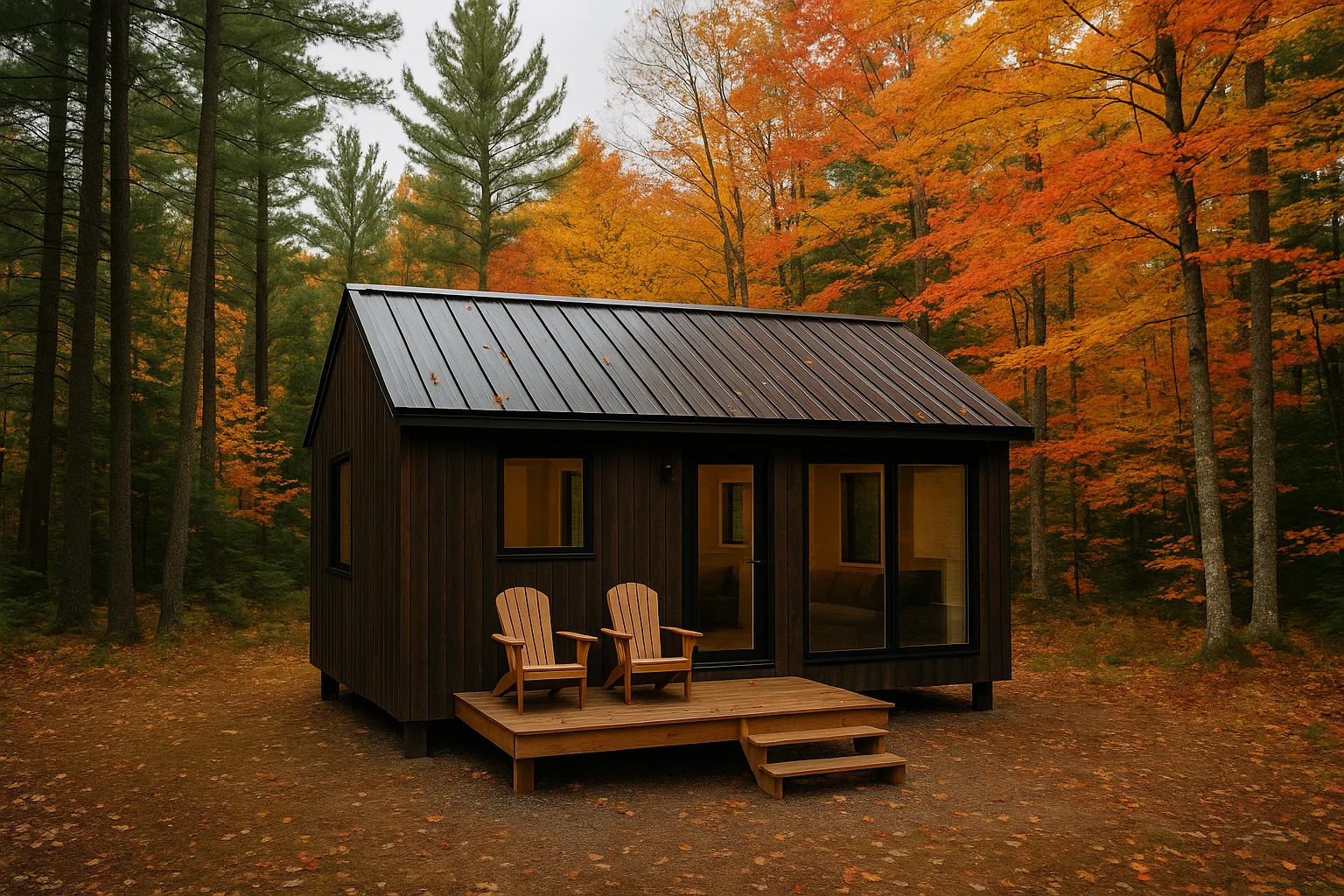
NH Tiny Home Laws: What's State Law and What's Town-Level (2026)
If you're planning to buy, build, or place a tiny home in New Hampshire, the legal framework breaks into two layers: state law sets the floor, and individual towns set what's actually allowed. State law requires every town to permit accessory dwelling units, but each municipality controls the specifics — minimum size, placement rules, zoning districts, and whether tiny homes on wheels qualify. This guide explains the state-level rules, the town-level variation, and how to figure out what's allowed at your specific address before you commit.
The State-Level Foundation: NH RSA 674:71–73 (ADU Law)
New Hampshire's accessory dwelling unit statute requires every municipality to allow at least one ADU per single-family lot — attached or detached from the primary residence. This opened the door for tiny homes statewide, but the law gives towns significant discretion.
What NH state law requires:
- Every town must allow ADUs in single-family residential zones (with permits).
- Towns can set their own size limits, design standards, and placement rules.
- Towns can require owner-occupancy of the primary residence or the ADU.
- ADUs can be attached (in-law apartments) or detached (standalone tiny homes on foundation).
What state law does NOT directly address:
- Tiny homes on wheels (THOWs) — classified as RVs under state vehicle code.
- Minimum dwelling size — each town sets this.
- Short-term rental of tiny homes — purely a town-level decision.
- Off-grid systems (composting toilets, rainwater catchment) — town health and septic regulations apply.
Tiny Homes on Wheels: The RVIA ANSI 119.5 Standard
NH treats most wheeled tiny homes as recreational vehicles, not real estate. The relevant standard is RVIA ANSI 119.5 — the RV construction code. RVIA-certified park models and THOWs can legally be placed in NH campgrounds, RV parks, and approved seasonal communities. They're covered by standard RV insurance and transferred like RVs, not real property. Most are restricted from year-round occupancy as a primary residence unless the town explicitly allows it.
Uncertified custom-built THOWs are legally murky — some towns treat them as RVs anyway, others require building code compliance, many simply have no clear position.
NH Towns Most Friendly to Tiny Homes
- Concord and surrounding Merrimack County towns — generally ADU-friendly with reasonable size and design standards.
- Keene and Monadnock Region (Cheshire County) — several towns have welcomed tiny home developments and eco-village concepts.
- Peterborough and Jaffrey — among the more progressive on alternative housing.
- Some Lakes Region towns (Moultonborough, Holderness) — generally ADU-friendly, though lake setback rules are strict.
- White Mountains corridor (Conway, Lincoln, Franconia) — variable; tourist-economy towns are sometimes more flexible for vacation and STR use.
NH Towns With More Restrictive Rules
- Some Seacoast towns (parts of Hampton, Rye, Exeter) — strict minimum dwelling sizes and design standards in certain zones.
- High-value lakefront towns — strict setbacks, design review, and minimum size standards that often exclude tiny homes.
- Towns without modern zoning ordinances — some rural towns effectively prohibit tiny homes by silence rather than explicit ban.
How to Verify Tiny Home Rules at a Specific NH Address
- Call the town's planning board or code enforcement office. Ask: "What's the minimum dwelling size in [zoning district]? Are detached ADUs permitted? Are RVIA park models permitted as ADUs or only in RV parks?"
- Request the town's ADU ordinance in writing. Most towns will email it.
- Check for recent ordinance updates — several NH towns updated ADU rules in 2024–2025.
- Verify septic and well requirements for the specific parcel.
- Confirm short-term rental rules separately if you plan to rent.
Permitting Process for Foundation-Set Tiny Homes in NH
- Site plan approval — typically required, $200–$1,500 in fees.
- Building permit — required for any new structure; includes code review (insulation, fire egress, electrical, plumbing).
- Septic system approval — required if connecting to a new or modified system.
- Total timeline — 8–20 weeks typical for a clean application.
For an RVIA park model placed in an established campground or RV park, the process is much simpler — typically just park operator approval and NH vehicle registration.
Year-Round Occupancy: The Town-Dependent Reality
Whether you can live in a tiny home year-round in NH depends entirely on the town and unit type:
- Foundation-set tiny homes as ADUs — usually permitted year-round in ADU-friendly towns.
- RVIA park models / THOWs — most often restricted to campgrounds and RV parks, not permitted as primary residences year-round without explicit town approval.
- Tiny homes on private rural land — highly variable; some towns allow it, some have minimum size requirements, some have no specific rules.
NH Rooms & Meals Tax on Short-Term Rentals
If you rent your tiny home short-term (under 185 days), New Hampshire's Rooms & Meals tax applies — currently 8.5% — and must be collected and remitted to the state. Some towns also require local STR registration with additional fees. Confirm both with the town and NH Department of Revenue Administration before listing.
Off-Grid Systems in NH
- Composting toilets — typically require state health department approval; may not satisfy local septic requirements.
- Rainwater catchment — allowed in most towns; potable water requires additional treatment.
- Solar power — generally allowed; net metering available through NH utilities.
- Greywater systems — variable by town health code.
Insurance by Unit Type
- RVIA-certified units — standard RV insurance ($500–$1,500/year typical).
- Foundation-set tiny homes — standard homeowner's insurance, sometimes with conditions around unit size.
- Uncertified custom THOWs — specialty insurance required; harder to source and more expensive.
Renting Out Your NH Tiny Home
For STR investors, listing on multiple platforms maximizes visibility. JmartBookings is a global rental marketplace where hosts pay only a 5% guest commission and listings show clear age and deposit policies.
How NH's Tiny Home Rules Compare to Other US Regions
New Hampshire's "state sets the floor, town sets the specifics" structure is typical of the Northeast region generally, where states like Maine (LD 2003, which preempts local single-family-only zoning) and Vermont (Act 47) have led with statewide ADU reform, while local rollout still varies town by town — New York remains the hardest Northeast state for full-time tiny-home living. NH sits in the middle of that spectrum: friendlier than New York, less uniformly permissive than Maine.
Compared to other US regions, the pattern generally looks like this:
- South / Appalachian region: Often more permissive in rural counties with minimal zoning enforcement — Texas and North Carolina are frequently cited as the most tiny-home-friendly states in the South, though metro areas within the same states can be far stricter.
- Midwest / Great Lakes / Great Plains: Mixed. Rural counties in Iowa, Missouri, and Kansas often have minimal zoning, but no Midwest state currently has California-style statewide preemption, and states like Indiana keep traditional zoning and minimum dwelling-size rules that limit adoption in many areas.
- West Coast / coastal states: Generally considered the most permissive region overall for tiny homes, with more state-level standardization than the Northeast.
- Northeast (NH's own region): Layered state-plus-town rules like NH's are the norm here, not the exception — expect to verify at the town level even where state law (like NH's RSA 674:71–73) sets a baseline.
The practical takeaway for NH specifically: because state law only sets a floor, NH will never be as uniformly simple as a state with full preemption. Verifying at the town level (see the section above) matters more here than it would in a state like Maine.
Bottom Line on NH Tiny Home Laws
State law requires every NH town to allow ADUs, which opens the door for foundation-set tiny homes statewide. The actual rules — minimum size, placement, occupancy type, short-term rental — are set by each town individually. RVIA-certified THOWs are typically restricted to campgrounds and RV parks unless the town explicitly allows them as ADUs. Call the specific town's planning board and get the rules in writing before buying.

Join the Discussion
No comments yet. Be the first to share your thoughts!